
Name the Bird
or don't

When it’s just me, paper and pen, writing is meditation as Krishnamurti describes it below. I jump in and the current takes me. Words are sent out like messengers, then called back, then sent out again until they’re moving together like a murmuration of starlings, a lamentation of swans, a murder of crows.
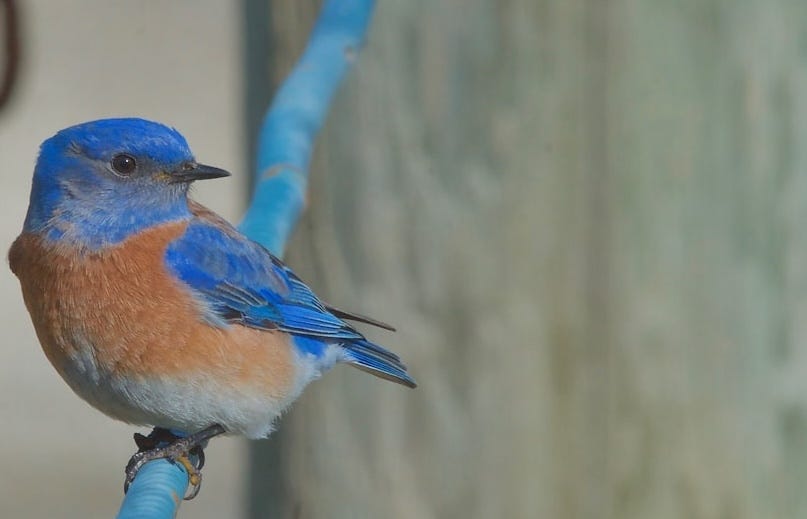
The day you teach the child the name of the bird, the child will never see that bird again. ~Krishnamurti, spiritual teacher, author
Of course, Krishnamurti did not mean we should not know the names of birds, simply that the label is not the living being. We stop seeing the robin, the wren, the eagle, if we think knowing a label is knowing the bird. Or knowing anything.
It’s not.
I love words and their etymologies. I acknowledge the mystical quality of language especially the oral traditions of Indigenous cultures that relied on a communal transmission of history and culture.1 Colonizers understood that taking away someone’s language was akin to individual and cultural erasure.
If we lived in a society guided by the sacred, we might say that naming the bird brings us into right relationship with it. But we, the non-indigenous, do not have that relationship with our language. We worship facts, or what we perceive as such. We codify cognitive intelligence with degrees and certifications, and forget about the lively intelligence that has nothing to do with cognitive thinking.
Clouds, fish, elements, flowers, trees—life on this animate earth—are essentially nameless, and knowing them in their nameless state—experiencing them somatically through meditation—is what Krishnamurti, a teacher with a radical view of meditation, points to.
Meditation is one of the greatest arts in life, perhaps the greatest, and one cannot possibly learn it from anybody. That is the beauty of it. It has no technique and therefore no authority. When you learn about yourself, watch yourself, watch the way you walk, how you eat, what you say, the gossip, the hate, the jealousy, if you are aware of all that in yourself, without any choice, that is part of meditation. So meditation can take place when you are sitting on a bus or walking in the woods full of light and shadows, or listening to the singing of birds or looking at the face of your wife, husband or child. ~Krishnamurti, On Meditation
White people (and I am one) have a history of “discoveries” but we uncover what was always there for the knowing. What we learn are gifts given by a generous universe—something our Indigenous ancestors understood—not “discoveries” to be hoarded, exploited or both.
As a child I often thought, why don’t adults see that we live in Eden? Why don’t they take care of the trees and oceans and animals?
It used to depress the hell out of me to ask those questions, and it still can. Writing poems, essays and stories helps me write through to the other side of sadness. And what’s on the other side? Compassion.
…compassion comes only when you understand the meaning of sorrow, not only the sorrow of yourself, but of your neighbor, of all the mothers, of all the sisters, all the wives that have been killed, who are shedding tears, who have shed tears. When you understand what sorrow means and remain - to understand it one has to remain with it, look at it, not escape from it, not try to justify it, then out of that total negation of all escapes, then out of that comes passion, and with it compassion which is love. ~Krishnamurti, from “Meditation is the Whole of Life”
Maybe it’s the way of humanoid creatures to crash through boundaries to chase the new thing glittering before them rather than keep their eyes on the trackless stars above.
We are stardust, we are golden
We are caught in the devil's bargain
And we've got to get ourselves
back to the gardenfrom Woodstock, by Joni Mitchell
We are born in Love.
Children of God.
Stardust.
NOTE regarding AI use: I do not use it. AI is not used in any part of my writing process: from conceiving and nurturing ideas, to editing drafts, to writing the final essay. This is the work of one human doing her best to write essays and poetry for her readers on a bi-weekly schedule. We don’t need more content of poor and dubious quality, we need thoughtful, heart-centered human content. ps: I love the em dash and use it whenever it makes sense to me to use it.
https://indigenousfoundations.arts.ubc.ca/oral_traditions/ See also David Abram The Spell of the Sensuous, and how written language created static records and histories that supplanted oral tradition, which was inherently communal and relational.
Naming things.. the hurt, the loss with academic critical thinking
the freedom of acknowledgment of Spirit in all Things … Thank you
Kathleen Kehoe